At a Glance
- Central auditory processing disorder is a difficulty with how the brain interprets sound rather than how well the ears detect it, which is exactly why it hides behind a normal hearing test.
- A standard hearing test measures the quietest tones you can detect in a silent booth, and it was never designed to measure how well you follow a conversation in a noisy room.
- In a 2023 study of adult audiology patients, about 15 percent had normal hearing thresholds, and 7 percent had normal thresholds while still feeling that something was wrong with their hearing.
- In adults the difficulty is often connected to normal aging of the hearing pathways, head injury, stroke, or a childhood problem that nobody identified at the time.
- Canadian national guidelines require a full assessment of the ear itself before any auditory processing testing begins, because the simpler explanations have to be ruled out first.
Central auditory processing disorder is a condition in which the ears detect sound normally but the brain has trouble organizing that sound into meaning, particularly speech competing with background noise. If an audiologist has told you your hearing is fine and you still cannot follow your friends at a restaurant, those two facts are not in conflict.
That combination is one of the more common reasons adults come to Toronto Hearing Consultants for a second look. We hear it described the same way most weeks: a patient who manages perfectly well one-to-one, then loses the thread completely in a busy room off Bloor Street, or gives up on a phone call with traffic going past on Bathurst.
This article explains what the condition is, why a standard test misses it, and what a diagnostic hearing test actually involves.
What Central Auditory Processing Disorder Is
Hearing happens in two stages, and the difference between them matters here. Your ears collect sound and convert it into nerve signals, and then your brain sorts those signals into words, voices, and meaning.
Central auditory processing disorder is a breakdown in the second stage, in the pathways that carry and interpret sound rather than in the ear itself. That distinction matters because the two stages fail in different ways.
When the ear is the problem, sound gets quieter. When processing is the problem, sound stays perfectly loud and simply arrives scrambled, which is why so many people describe it as hearing everything and understanding nothing.
The condition is usually associated with children, and that association is part of why adults go so long without an answer. Adults are frequently assessed for the first time after years of difficulty they had learned to work around.
Why Your Hearing Test Came Back Normal
A standard hearing test, called pure tone audiometry, asks you to press a button when you hear a faint beep at different pitches, one ear at a time, inside a quiet booth. It is a good test, and it answers its question precisely: how quiet can a sound be before you stop detecting it?
The trouble is that this question is not the one you came in with, because nobody struggles to hear beeps in silence. What you actually struggle with is hearing your daughter-in-law across a table while an espresso machine runs and four other conversations overlap.
A silent booth removes every one of those variables, so a listening problem that only appears in noise has nowhere to show up. A 2023 study in Scientific Reports found that about 15 percent of adult audiology patients had normal hearing thresholds, and that 7 percent had normal thresholds while still reporting that something was wrong with their hearing.
The two tests answer different questions, and reading them side by side is usually the moment it clicks. A standard hearing test measures the quietest tone you can detect at each pitch, one ear at a time, in near-silence, which is the easiest possible condition for your auditory system. A normal result there tells you your ears are detecting sound normally, and it will miss any difficulty that only appears once background noise is added.
An auditory processing assessment measures something else: how accurately your brain handles speech that is rushed, degraded, or competing with other sound. It uses background noise, and two different messages at once, which is far closer to a real restaurant. A normal result there tells you your brain is organizing sound into meaning reliably. On its own it misses nothing, because it cannot be interpreted at all until ear function has been checked first.
A normal audiogram is an accurate answer to a narrow question, and the narrowness is the whole problem.
Who runs the test matters as much as which test is run. An audiologist registered with the College of Audiologists and Speech-Language Pathologists of Ontario holds a Master's or Doctoral degree in audiology, which is the training that covers auditory processing assessment and the medical referral decisions around it. A hearing instrument specialist completes a college programme focused on testing for the purpose of fitting hearing aids. Both are licensed professionals doing legitimate work, and only one of them is trained to run and interpret this particular battery.
What It Looks Like in Adults
Adult presentations tend to cluster around effort rather than volume. Kim Tillery, a professor of communication disorders, describes adults reporting difficulty on the telephone, trouble keeping up with rapid speech or long spoken instructions, and weak memory for things heard rather than read.
She also notes sound discrimination errors, such as hearing "poultry" when someone said "poetry." Two further patterns come up often in our clinics: noise becomes actively intolerable rather than merely annoying, and music loses some of its richness and appeal.
The common thread is that listening costs you something. People with normal ears and inefficient processing spend real mental energy reconstructing sentences from partial information, and that effort shows up as exhaustion after a dinner party, a meeting, or a long phone call.
The Three Routes Into It in Adulthood
There are three broad routes into the condition in adulthood, and they are worth separating because they carry different implications.
The first route is ordinary aging of the hearing pathways. The central auditory nervous system, meaning the nerve pathways and brain regions that carry and interpret sound, changes with age in the same way other neural systems do. Processing can slow even when the ear itself holds up well, which is one reason older adults often report that speech has become fast rather than quiet.
The second route is neurological injury or disease. Tillery lists traumatic brain injury, stroke, multiple sclerosis, and Alzheimer's disease among the conditions associated with adult auditory processing difficulty. If your listening changed noticeably after a concussion or a medical event, that timing is clinically meaningful and worth reporting to your audiologist.
The third is a childhood difficulty that was never identified. Plenty of adults describe a lifetime of being called a poor listener at school, and only recognize the pattern once someone finally names it.
How the Assessment Actually Works
Canada has national guidance on this. The Canadian Guidelines on Auditory Processing Disorder in Children and Adults, published through Speech-Language and Audiology Canada, set out the sequence with an unambiguous first step: assess the ear before assessing the processing.
That first stage includes pure tone audiometry, immittance testing with acoustic reflexes, which checks how the eardrum and middle ear muscles respond to sound, speech recognition testing, and otoacoustic emissions, which measure the faint sounds a healthy inner ear produces on its own. Skipping this stage risks attributing a problem to the brain when it belongs to the ear.
Only then does processing testing begin, and it uses tasks that deliberately make listening harder. We run that stage in the sound booths at our Bloor West Village and Annex clinics, using the same screening battery the research supports. The Scientific Reports study evaluated which tasks best identify adults who should be referred for full assessment, and these are the three we rely on.
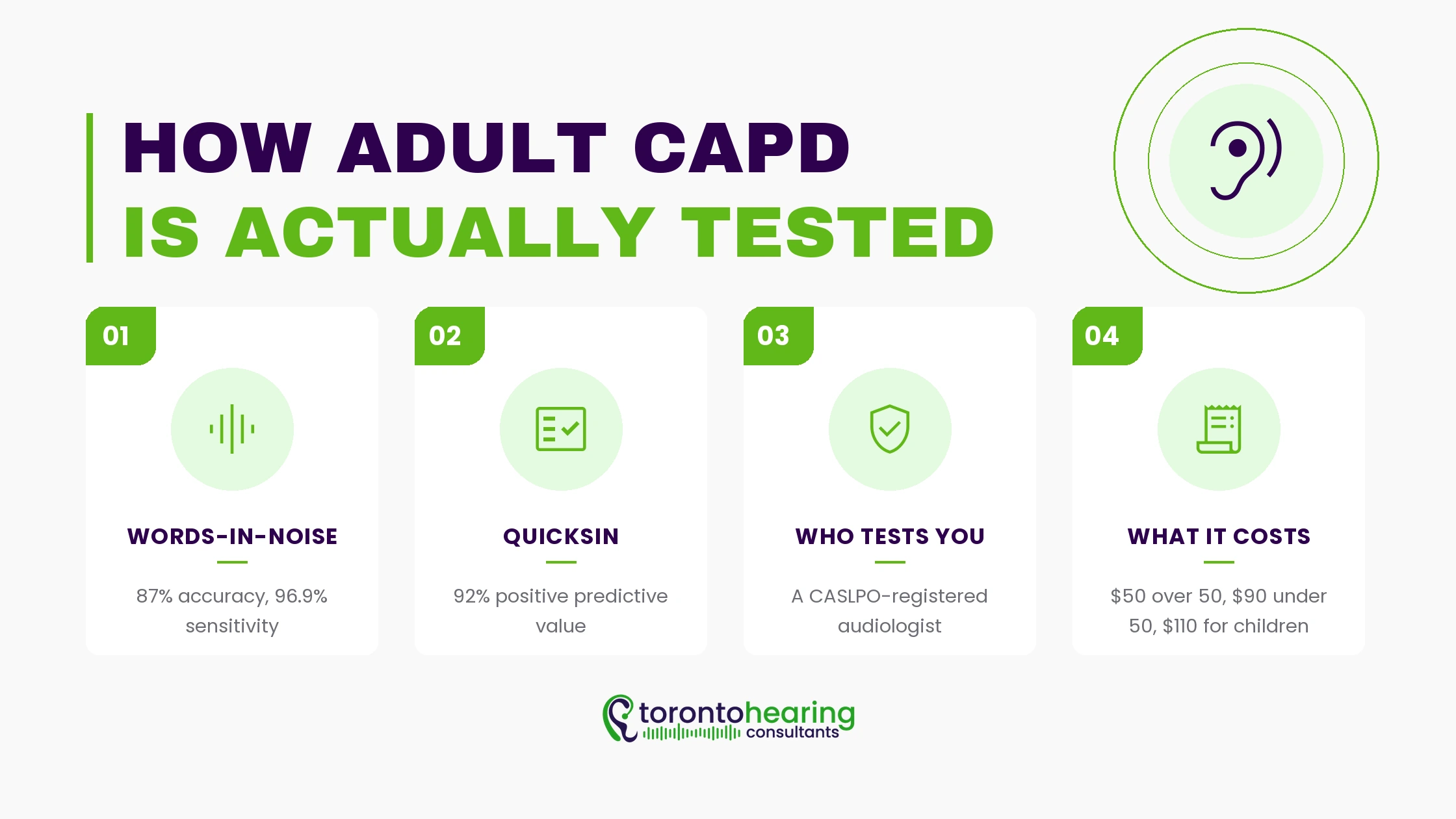
- The Words-in-Noise test reached 87 percent accuracy with 96.9 percent sensitivity.
- The Random Dichotic Digits Task, which presents different numbers to each ear simultaneously, reached 80 percent accuracy.
- The Quick Speech-in-Noise test produced the highest positive predictive value at 92 percent.
Those numbers are worth reading carefully. High sensitivity means a test rarely misses someone who really has the condition, which is precisely what you want from a screening tool.
Processing, Hearing Loss, or Attention?
This is the question a full assessment exists to answer, and guessing at it from symptoms alone is unreliable. Difficulty following speech in noise is also an early sign of ordinary age-related hearing loss, a symptom of one-sided hearing loss, and a feature of attention difficulties that have nothing to do with the ears.
A thorough assessment separates these because each stage tests a different link in the chain, and the pattern of results points somewhere specific.
- Ordinary hearing loss shows up on the audiogram itself, as reduced sensitivity at particular pitches.
- Hidden hearing loss leaves the audiogram clean while speech-in-noise scores fall, because the damage sits in the connections between hair cells and the auditory nerve rather than in threshold sensitivity.
- An auditory processing difficulty leaves both the audiogram and ear function normal, with the losses appearing on dichotic and degraded-speech tasks instead.
- An attention difficulty tends to affect performance across the board rather than tracking with listening condition, which is why the pattern across tasks matters more than any single score.
Ear function is measured directly, processing is measured under controlled degradation, and the shape of the results tells us which of those four we are looking at.
Two people describing identical restaurant trouble can walk out with entirely different diagnoses. The Canadian guidelines frame the goal well by shifting the emphasis from cause to impact, which in practice means the assessment is judged by whether it explains your actual difficulty in your actual life.
What Happens After an Assessment
Nobody can offer you a cure, and any clinic that suggests otherwise is overselling. Management works on three fronts instead, and it works well enough to change how tiring your week feels.
Environmental changes come first because they cost nothing and help immediately: choosing the quiet side of a restaurant, sitting with your back to a wall, and asking for the important sentence to be rephrased rather than repeated. Auditory training then exercises the specific skills that testing showed to be weak.
Where hearing loss coexists with processing difficulty, well-fitted amplification or a remote microphone can improve the signal reaching a brain that needs all the help it can get.
Toronto Hearing Consultants offers central auditory processing disorder testing at both our Bloor West Village and Annex clinics, and because we are an independent, audiologist-led practice, the assessment leads wherever the results lead. Every assessment starts with a full diagnostic hearing test, which is what the Canadian guidelines require and what tells us whether the ear or the pathway is the issue.
We also assess children's hearing and provide tinnitus support, which often accompanies auditory processing complaints.

Book an Assessment That Tells You Which Problem You Have
Ordinary hearing loss, hidden hearing loss and a processing difficulty produce the same complaint at the same restaurant table. Only a full diagnostic assessment separates them, and the answer determines whether hearing aids, auditory training, or a medical referral is the right next step.
Our diagnostic assessment is $50 for patients over 50, $90 for patients under 50, and $110 for children, and private insurance plans commonly reimburse it. Audiology diagnostics are not covered by OHIP, so there is no referral to chase and no waiting list to join.
Auditory processing testing is available at both our Bloor West Village and Annex clinics, for anyone aged seven and over. Book a hearing assessment and let us find out which part of the chain is struggling.
Frequently Asked Questions
Can Adults Develop Auditory Processing Disorder Later in Life?
Yes, and it is more common than the childhood association suggests. Adult cases are associated with normal aging of the hearing pathways, traumatic brain injury, stroke and other neurological conditions, and the difficulty often appears after a concussion or a medical event the patient can date precisely. A second group have had it since childhood without anyone identifying it, and only recognise the pattern decades later. Either way the assessment is the same, and the timing of the change is among the most useful things you can tell your audiologist.
Can You Have Auditory Processing Disorder With Perfect Hearing?
Yes, and that combination is the defining pattern rather than an exception. The ears detect sound normally, the audiogram looks clean, and the difficulty appears only once the brain has to organise that sound into meaning under harder conditions. A 2023 study found roughly 15 percent of adult audiology patients had normal thresholds, and 7 percent had normal thresholds while still reporting something was wrong. A clean hearing test rules out one explanation, not the problem itself.
How Is Auditory Processing Disorder Tested in Adults?
Testing begins with a complete assessment of ear function, because Canadian guidelines require the simpler explanations be ruled out first. That stage covers pure tone audiometry, immittance testing with acoustic reflexes, speech recognition and otoacoustic emissions. Only then does processing testing begin, using tasks that degrade speech deliberately: words presented in background noise, and different numbers played to each ear simultaneously. We run that battery in the sound booths at both clinics, and the whole appointment takes about an hour.
Will Hearing Aids Help Auditory Processing Disorder?
They help when hearing loss is present alongside the processing difficulty, and a remote microphone can help further by improving the signal that reaches the brain before any processing has to happen. Amplification alone does not correct a processing problem, because making a scrambled signal louder leaves it scrambled. That is precisely why the assessment comes first. Fitting hearing aids to someone whose ears are working normally spends money without addressing what is actually going wrong.
Is Auditory Processing Disorder the Same as Attention Deficit Hyperactivity Disorder?
No, though they can look similar from the outside and can occur together in the same person. An attention difficulty tends to affect performance fairly evenly across tasks, while a processing difficulty tracks with listening condition and worsens sharply once speech is degraded or competing. A full auditory processing assessment is designed to tell those apart by testing each link in the chain separately, which is something no questionnaire or symptom checklist can do reliably.