Key Takeaways
- Earwax only needs removing when it causes symptoms such as muffled hearing or a plugged feeling, because healthy ears usually clear themselves.
- A few days of softening drops often clear mild buildup at home, and softened wax is easier and more comfortable to remove if you still need an appointment.
- Both microsuction and low-pressure irrigation can safely remove earwax. Your audiologist chooses the method based on the wax, its position in the ear canal, and your ear health history.
- Low-pressure irrigation works well in a healthy ear with softened wax, but it is not used with a perforated eardrum, ear tubes, previous ear surgery, an active infection or a history of vertigo.
- Having wax removed at a hearing clinic means your hearing can be checked at the same visit, which matters most if you wear hearing aids.
Does one ear feel blocked, or have you noticed that conversations sound muffled even though people are speaking clearly? Maybe you're turning up the TV more than usual, experiencing ringing in your ears, or finding that your hearing aids aren't working as well as they should. These can all be signs of earwax buildup, especially when wax becomes impacted and starts affecting your hearing.
Earwax removal is the clinical process of clearing built-up cerumen from the ear canal, usually with softening drops, microsuction, or irrigation. While earwax itself is healthy, too much can cause discomfort, a feeling of fullness, earaches, and sometimes dizziness. It normally protects your ears by trapping dirt and debris and helping prevent the ear canal from drying out. Problems arise when wax collects faster than it can naturally move out of the ear. You might notice muffled hearing or, if you wear hearing aids, find that they're sounding weak or whistling.
If earwax is causing these symptoms, professional earwax removal can help clear the blockage. At Toronto Hearing Consultants, your clinician first examines your ears to check whether wax is responsible. Depending on what they find, removal may involve softening drops, microsuction, or irrigation. Understanding how these methods work can help you decide whether home care is appropriate or it's time to book an appointment.
Which Ear Wax Removal Method Is Best?
Which method you need depends on your ear's history and what your audiologist sees during the examination.
| Method | How it works | Suits | Main limitation |
|---|---|---|---|
| Softening drops | Oil or cerumenolytic drops from a pharmacy soften the wax so it can work its way out | Mild buildup or wax that needs softening before removal | Takes several days, and is not suitable with a perforated eardrum |
| Microsuction | A thin suction probe lifts the wax out under direct magnified vision | Wax that requires suction removal, including ears where irrigation is unsuitable | Needs specialized equipment and a trained clinician, such as an audiologist |
| Irrigation | Warm water at low, controlled pressure flushes the wax out | Softened wax when the eardrum is healthy, and there are no contraindications | Not used with a perforation, ear tubes, previous surgery, infection, or vertigo |
How Audiologists Choose Between Microsuction and Irrigation
Both microsuction and low-pressure irrigation are safe methods of earwax removal when used appropriately. Your audiologist will examine your ears first, looking at how soft or firm the wax is, how deep it sits in the ear canal, and whether you have any medical history that affects which method can be used.
If the wax is soft and your eardrum is healthy, low-pressure irrigation is often a good choice. It uses a controlled flow of warm water to gently flush the wax out without putting excessive pressure on the eardrum.
Microsuction removes wax using a small suction device under magnification. It can be used for many types of wax and is particularly helpful if you have ear tubes, a perforated eardrum or a history of ear surgery that makes irrigation unsuitable.
Some blockages are more difficult to clear and may require a combination of both methods. Your audiologist will choose the approach that works best for your ears rather than using the same method for every appointment.
When Are Drops Enough?
For mild buildup, softening drops are often enough on their own, and they are inexpensive and easy to use at home.
Use a pharmacy wax softener (cerumenolytic drops) or a gentle oil for several days, following the product directions, so the wax can loosen and work its way out. Skip drops if you know or suspect a perforated eardrum, and avoid almond oil if you have a nut allergy.
If your ear still feels blocked after a week of drops, that is a good time to book a removal. Softened wax is easier and more comfortable to clear, and professional-grade softening drops are also available at our clinics.
See your family doctor or a walk-in clinic sooner if the blockage came on suddenly with hearing loss, or if you have pain, discharge, or fever, because those signs need a medical assessment.
How Ear Irrigation Has Changed
Ear irrigation uses a gentle, controlled flow of warm water to flush softened earwax out of the ear canal. Unlike traditional ear syringing, which relied on a hand-operated syringe and pressure controlled by the person performing the procedure, modern irrigation equipment regulates the water pressure and flow. This makes the process more controlled, although it still requires a careful examination of the ear beforehand.
Irrigation isn't suitable for everyone. If you have a perforated eardrum, ear tubes, certain previous ear surgeries, an active ear infection, or a history of vertigo, your audiologist will assess whether another method is more appropriate. When the wax is soft and there are no reasons to avoid irrigation, low-pressure irrigation can remove it safely and effectively. Firmer or deeper wax may require microsuction or a combination of methods.
What Is Safe to Use on Your Ears at Home?
Softening drops are the safest home option, and keeping other objects out of the ear canal protects its thin skin and the eardrum.
Cotton swabs push wax deeper. A swab removes a little wax from the opening and packs the rest toward the eardrum, which can turn mild buildup into a blockage.
Ear candles do not remove wax. Health Canada says ear candling has no proven medical benefit and has been linked to burns, punctured eardrums, and wax blockages.
Home suction devices are not a substitute for an examination. Without magnification, there is no way to see the eardrum or confirm that wax is the cause.
Anything rigid inserted into the canal also risks scratching the skin, which can lead to infection.
What Happens at an Ear Wax Removal Appointment?
Most appointments are short, and your audiologist explains each step as it happens.
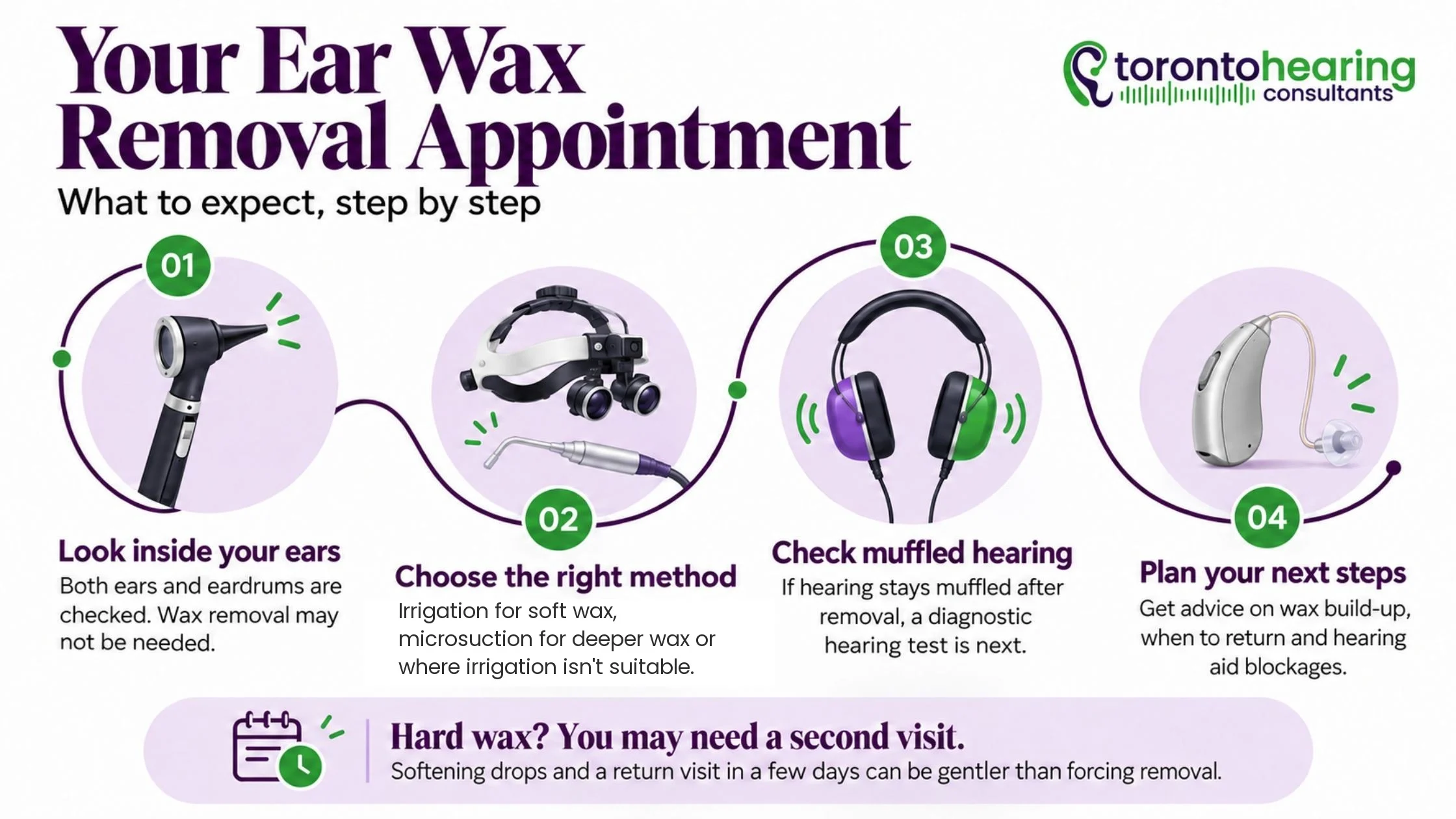
We start with otoscopy. Your audiologist looks into both ears before touching anything, to confirm wax is the cause, check the eardrum, and look for signs that may be consistent with infection. Sometimes no removal is needed because the wax is not blocking anything and the symptom has another cause.
Your audiologist chooses the removal method. Soft wax can often be cleared with low-pressure irrigation, while microsuction may be more suitable for deeper wax or ears where irrigation isn't recommended. Some blockages need both methods. The decision is based on what your audiologist sees during the examination and your ear health history.
We check your hearing if it still sounds muffled. If muffled hearing was part of why you came in, we check whether it has cleared once the wax is gone. If it has not fully returned, a diagnostic hearing test is the next step.
We explain what to expect next time. Some people produce more wax than others, and some ear canal shapes hold on to it. If that is you, we explain why and what to watch for, and recommend removal only when wax causes symptoms or affects your hearing aids. If you wear hearing aids, we can also check that wax has not blocked them, since a blocked receiver can make them sound weak or whistle.
Occasionally wax is too hard to remove comfortably in a single sitting. In that case we send you home with drops and see you again in a few days, which is gentler on your ear than forcing it.
When Should You See Someone Rather Than Wait?
Book an appointment if muffled hearing, a blocked feeling or earache has not improved after about a week of drops. See a doctor sooner if an ear is completely blocked, if the change came on suddenly, or if there is pain, discharge, or fever. If you have had ear surgery, skip home treatment and have the ear examined first.
If your main symptom is ringing rather than blockage, wax is worth ruling out first, since it is one of the treatable causes of tinnitus.
Audiologist-Led Ear Wax Removal
Removal at Toronto Hearing Consultants is carried out by a CASLPO-registered audiologist; no referral is required, and fees are explained before we begin.
Because removal happens in a hearing clinic, the audiologist who clears your ear can also check your hearing at the same visit if it has not fully returned. Visit our ear wax removal in Toronto page to see both clinics and book.
Frequently Asked Questions
Is Microsuction Safer Than Ear Irrigation?
Neither method is automatically safer than the other. Both microsuction and modern low-pressure irrigation can be performed safely by a trained audiologist. Irrigation works well for softened wax when the eardrum is healthy and there are no medical reasons to avoid it. Microsuction is often used when irrigation isn't suitable, such as with a perforated eardrum, ear tubes or certain previous ear surgeries. Your audiologist will examine your ears before deciding which method to use.
Ear Irrigation vs Microsuction: Which Is Better?
The best method depends on the type of earwax, how deep it sits in the ear canal and your ear health. Low-pressure irrigation is often used for soft wax when the eardrum is healthy, gently flushing it out with warm water. Microsuction may be more suitable for deeper or harder-to-reach wax and is often used for people with ear tubes, a perforated eardrum or a history of ear surgery. Stubborn blockages sometimes require a combination of both methods. Your audiologist will examine your ears and choose the method that is most appropriate for you.
Can I Remove Ear Wax at Home?
Yes, you can soften it at home, which often clears the problem. Use a pharmacy wax softener (cerumenolytic drops) or a gentle oil for several days, following the product directions, and skip drops if you know or suspect a perforated eardrum. Keep everything else out of the ear canal: cotton swabs pack wax toward the eardrum, and Health Canada advises against ear candling. If your ear still feels blocked after a week, book a removal, since softened wax is easier to clear.
How Long Does Ear Wax Removal Take?
The removal itself usually takes a few minutes per ear, with the appointment allowing time for otoscopy beforehand and a check afterwards. Very hard or long-standing wax sometimes cannot be removed comfortably in one visit; in that case, a few days of drops and a second appointment work better. We would rather bring you back than force a painful removal or risk irritating the canal. Most people can return to their day right away.
Do I Need a Referral for Professional Ear Wax Removal?
No. You can book directly at either of our two Toronto clinics without a referral from a physician. If the examination shows something other than wax, such as signs that may be consistent with infection, a perforation, or a hearing loss unrelated to the blockage, we will explain what we see and refer you to your doctor when it needs medical care. Booking directly also means the same audiologist can check your hearing once the wax is cleared.
Should I See a Doctor or an Audiologist for a Blocked Ear?
Either can help. An audiologist can examine your ear, remove the wax at the same visit, and check whether your hearing has returned; in Ontario, you can book without a referral. See your family doctor or a walk-in clinic first if the blockage came on suddenly with hearing loss, or if you have pain, discharge, or fever, because those signs need a medical assessment. If a week of drops has not cleared it, book a removal, since softened wax is easier and more comfortable to clear.