Key Takeaways
- Tinnitus treatment today focuses on management, which means making the sound less intrusive and less stressful, because no medication or supplement has been shown to cure it.
- For ringing that has lasted more than a few days with no warning signs, an audiologist is a good first stop, and in Ontario you don’t need a referral from your family doctor.
- A tinnitus assessment can test hearing beyond the frequencies measured in a standard hearing test. Extended high-frequency testing may detect hearing loss even when a regular audiogram shows normal results.
- Hearing aids, sound enrichment, counselling and cognitive behavioural therapy have the most support, and the right mix depends on your hearing and on how much the tinnitus bothers you.
- Sudden hearing loss in one ear, a sound that beats in time with your pulse, or ringing with dizziness should be checked by a doctor promptly.
Tinnitus management helps you cope with ringing, buzzing or hissing sounds that have no external source, so they interfere less with your daily life. Depending on your symptoms and hearing needs, this may include sound therapy, hearing aids or practical strategies to help you manage tinnitus during everyday activities, especially when you're trying to concentrate, relax or sleep. If you are still working out whether the sound you hear is tinnitus, you can learn about the signs of tinnitus first.
For most adults, that care begins with a hearing assessment and continues with a personal plan built around hearing support, background sound, and clear information. Tinnitus is very common in Canada: Statistics Canada reported that about 37 percent of adults experienced it in the past year, and for 7 percent it was bothersome enough to affect sleep, concentration or mood. To learn more about tinnitus symptoms you may be experiencing, and how tinnitus affects hearing loss, you can schedule an appointment or reach out to discuss your symptoms with us.
A standard hearing test doesn't always explain why someone experiences tinnitus. Some people have normal results but show hearing loss when higher pitches are tested. Our tinnitus assessments look more closely at these changes and how tinnitus affects your sleep, concentration, and daily activities. Your results help us determine whether hearing aids, sound therapy, or other management strategies may help.
Who Should You See First for Tinnitus in Toronto?
If you've had ringing, buzzing, or hissing in your ears for more than a few days, consider booking an appointment with an audiologist. Audiologists specialize in hearing health and can test your hearing, assess your tinnitus, and recommend management options based on your symptoms. In Ontario, audiologists are regulated by the College of Audiologists and Speech-Language Pathologists of Ontario (CASLPO).
You can book directly with an audiologist in Ontario without a referral from your family doctor. When making your appointment, mention any other symptoms, including a blocked or plugged feeling in your ears, since earwax buildup can sometimes contribute to tinnitus. If you experience sudden hearing loss along with tinnitus, seek urgent medical attention. Your audiologist will look in your ears first and can arrange ear wax removal before any testing, since wax can affect the results.
Who Treats Tinnitus in Toronto?
Depending on your symptoms, you may see one or more of these professionals:
- An audiologist tests your hearing, measures your tinnitus, fits hearing aids, and sets up sound enrichment, and you can book directly without a referral.
- A family doctor reviews your general health and current medications, and refers you to a specialist when something needs a closer look.
- An ear, nose and throat specialist, also called an otolaryngologist, looks for medical causes in the ear and head, and in Ontario a doctor's referral is needed for that visit.
- A psychologist or other trained mental health professional can provide cognitive behavioural therapy when tinnitus is affecting sleep, mood or concentration.
If you have ongoing ringing in both ears, an audiologist can check whether hearing loss is contributing to your tinnitus. Your hearing test can also identify differences between your ears and help determine whether hearing aids or other tinnitus management options may help. If your symptoms or test results suggest an underlying medical condition, your audiologist may recommend seeing your family doctor or an ear, nose and throat (ENT) specialist for further assessment.
When to See a Doctor First
A few patterns call for a medical check before, or alongside, a hearing appointment. They are uncommon, and most tinnitus has a straightforward explanation, but they are worth ruling out.
- Sudden hearing loss in one ear needs attention the same day. A Canadian review in the Canadian Medical Association Journal explains that sudden hearing loss in one ear, which often comes with tinnitus, should be treated as urgent because early treatment matters. See your family doctor, a walk-in clinic or an emergency department right away.
- A whooshing or thumping sound that keeps time with your heartbeat is called pulsatile tinnitus, and a doctor will want to look for the cause.
- Tinnitus in one ear only, or uneven hearing between your ears, is one of the situations where a review in Canadian Family Physician recommends referral to an ear, nose and throat specialist.
- Tinnitus that comes with dizziness, a spinning sensation or facial weakness, or that starts after a head injury, needs a doctor's assessment promptly.
- Tinnitus can weigh on your mood, and support is there when it does. If it leaves you feeling hopeless or you have thoughts of harming yourself, call or text 9-8-8, the Suicide Crisis Helpline, at any time.
Your audiologist asks about all of these during the first visit and will refer you to your doctor or an ear, nose, and throat specialist if anything points that way. Our role is to assess your hearing and your tinnitus, not to diagnose or treat medical conditions.
What Does a Tinnitus Assessment Involve?
A tinnitus assessment looks at both your hearing and how tinnitus is affecting you. The appointment costs $200 and includes more detailed testing than a standard hearing assessment.
Here's what you can expect:
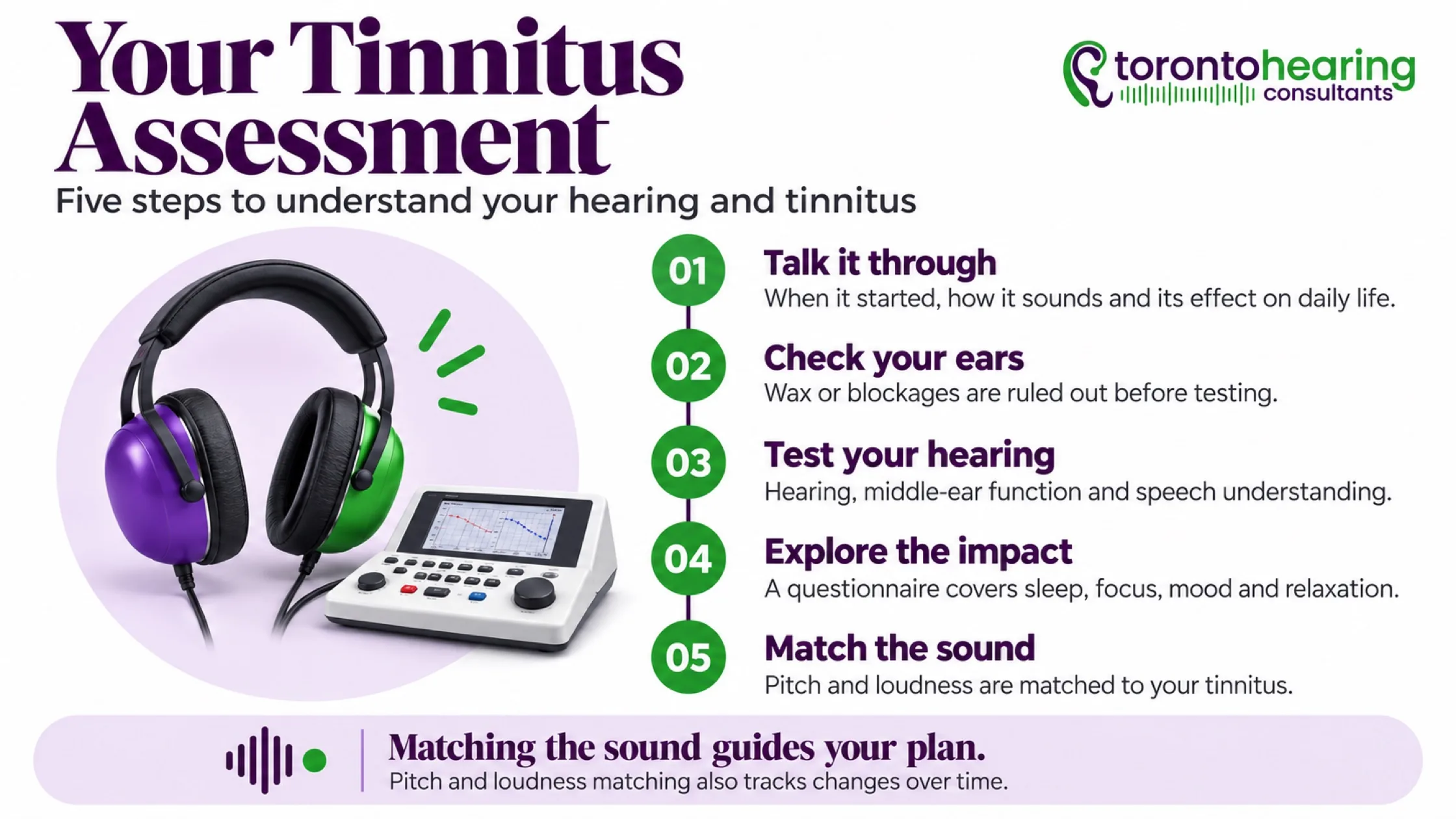
- A discussion about your tinnitus. Your audiologist will ask when the ringing or buzzing started, whether you hear it in one ear or both, and how it affects your sleep, concentration, work or school.
- A hearing assessment that includes extended high frequencies. Standard hearing tests typically measure pitches from 250 Hz to 8,000 Hz. Extended high-frequency testing goes up to 20,000 Hz (20 kHz), allowing your audiologist to check for hearing changes that may not appear on a regular audiogram.
- A Tinnitus Functional Index (TFI) questionnaire. This measures how much tinnitus is affecting different parts of your life, including sleep, concentration, and emotional well-being.
- A chance to try sound therapy. Your audiologist can demonstrate hearing aids with built-in sound therapy during your appointment or arrange a take-home trial so you can see whether the devices help.
- Practical advice and supporting documentation. You'll discuss strategies for managing tinnitus at home, work or school. Your audiologist can also prepare a supporting letter for workplace or school accommodations when appropriate, based on your TFI results.
Before you leave, your audiologist will review your findings and explain which management options may be suitable for you.
A tinnitus assessment is a structured appointment that measures your hearing and describes your tinnitus in numbers, so that the plan fits what is happening in your ears. At our clinics, it typically includes the following steps.
We also ask whether everyday sounds have started to feel too loud. Hyperacusis is a reduced tolerance to everyday sounds, such as dishes clattering or a busy restaurant, and it often appears alongside tinnitus. If it is part of your picture, it shapes the plan, because the aim is to rebuild comfort with sound gradually rather than to block sound out.
After your assessment, your results are reviewed with you in clear, practical terms. Natasha Manji (M.Cl.Sc., Reg. CASLPO) recommends retesting hearing every three years when results are normal, and every year when hearing loss is found. Repeating your tinnitus measurements at those visits can show how your plan is working. Book a hearing test at either of our clinics to understand your tinnitus.
Can You Have Tinnitus With a Normal Hearing Test?
Yes. A standard audiogram measures hearing across frequencies from approximately 250 Hz to 8,000 Hz. You can have normal results across that range and still experience tinnitus.
One possible explanation is hearing loss at higher frequencies that aren't included in a standard test. Extended high-frequency testing measures pitches up to 20,000 Hz and may reveal hearing changes that would otherwise go undetected.
A study of extended high-frequency hearing loss in people with tinnitus found that some adults with normal results on a standard audiogram had hearing loss at higher frequencies. These changes can be measured through extended high-frequency testing, although they don't explain every case of tinnitus.
If you've been told your hearing is normal but the ringing continues, a tinnitus assessment can provide a more detailed picture of your hearing and help your audiologist recommend suitable management options.
How Pitch and Loudness Matching Work
Pitch and loudness matching are tests that describe your tinnitus using the same units as your hearing test. They replace a vague description, such as "a high whine," with measurements your audiologist can plan around and track over time. The Canadian Academy of Audiology lists these as core tinnitus measures.
- Pitch matching asks you to listen to a series of tones and noises through inserts in your ears and choose the one that sounds most like your tinnitus. Many people find their tinnitus pitch sits near the pitches where their hearing has dropped, which helps guide how hearing aids are programmed.
- Loudness matching raises the matching sound in small steps until it sounds as loud as your tinnitus. Loudness is measured in decibels, the same scale used for your hearing test.
- Minimum masking level is the softest background noise that covers your tinnitus, and it shows how much sound enrichment is likely to be needed.
- Residual inhibition describes tinnitus that goes quiet for a short time after the masking noise stops, and knowing whether this happens to you helps when choosing a sound strategy.
One result surprises many patients: the loudness match often lands only a few decibels above the softest sound you can hear, even when the tinnitus feels loud at night. That gap tells us something useful: much of what makes tinnitus hard to live with is how strongly the brain attends to and reacts to it, and that reaction is what good management can change.
Sound Therapy and Sound Enrichment: How They Work
Sound therapy is the use of gentle, steady background sound to make tinnitus less noticeable. This approach is also called sound enrichment. Tinnitus tends to stand out most in quiet rooms and at bedtime, and a soft layer of sound reduces that contrast.
Sound enrichment can be as simple as a fan, a bedside sound machine, or a nature sound app. It can also be built into hearing aids, many of which include tinnitus programs that play soft noise or gentle tones you can stream or adjust from your phone.
Two related terms come up often when people read about sound therapy. Masking means using a sound loud enough to cover the tinnitus completely, while current practice usually favours a softer level that blends with it, so the brain can get used to the tinnitus over time. Tinnitus retraining therapy is a longer program that combines structured counselling with soft background sound over many months, with the goal of the brain learning to treat tinnitus as unimportant background.
When Do Hearing Aids Help With Tinnitus?
Hearing aids may help reduce tinnitus even when hearing loss is mild or isn't detected during a standard hearing test. Some people have hearing loss at frequencies above 8,000 Hz, which can be identified through extended high-frequency testing. The connection between hearing loss and tinnitus is important because reduced hearing can make ringing or buzzing more noticeable.
Research suggests that hearing aids can make tinnitus less noticeable for some people with hearing loss. A review published in Canadian Family Physician recommends hearing aids for tinnitus associated with significant hearing loss. However, people with milder hearing changes may also benefit. Premium hearing aids with an extended high-frequency range may be worth considering when testing identifies hearing loss at higher pitches. Your audiologist will check whether the devices can amplify the affected frequencies and whether they're appropriate for your hearing.
Many hearing aids also include sound therapy programs that play gentle background sounds to make ringing or buzzing less noticeable, particularly in quiet environments.
If your hearing is normal across all the frequencies tested, you may still benefit from sound therapy. Ear-level sound therapy devices look similar to hearing aids but provide background sound without amplifying other sounds.
Your audiologist will explain which option suits your hearing and tinnitus symptoms. You can try a device with sound therapy during your appointment or arrange a take-home trial to see whether it helps before making a decision.
What the Evidence Supports for Tinnitus Treatment
A 2026 review in Canadian Audiologist, the Canadian Academy of Audiology's journal, sets out the main approaches to tinnitus management. The table summarizes where the main options stand for adults with persistent tinnitus.
| Approach | What it does | Where the evidence stands |
|---|---|---|
| Education and counselling | Explains what tinnitus is and reduces the worry that keeps attention on it. | Counselling is central to tinnitus care, and a 2019 trial of tinnitus retraining therapy found people improved even when the sound device was a placebo, which points to the value of the counselling itself. |
| Cognitive behavioural therapy | Teaches practical ways to change how you think about and respond to tinnitus. | A Cochrane review found it may reduce the impact of tinnitus on quality of life, with few side effects, and the Canadian Audiologist review recommends referral to a trained mental health professional. |
| Hearing aids | Amplify sounds when hearing loss is present and may include tinnitus sound therapy. | Research suggests hearing aids may reduce tinnitus symptoms for some people with hearing loss, including mild hearing loss. Results vary, and evidence comparing specific technologies remains limited. |
| Sound enrichment | Provides gentle background sound through hearing aids, ear-level sound generators, or other devices. | May help make tinnitus less noticeable, particularly in quiet environments. Research has not established that one sound therapy device works best for everyone |
Cognitive behavioural therapy is delivered by psychologists and other trained mental health professionals rather than audiologists. Your family doctor can help you find a provider, and your audiologist can share your assessment results so the care fits together.
How to Judge Tinnitus Products and Cure Claims
Because tinnitus is so common, many products promise to make it disappear. A few questions help separate a useful tool from an expensive detour.
- Does the product promise to cure your tinnitus for good? Current care aims to make tinnitus quieter and less bothersome, so a promised cure is a claim that goes beyond what the research shows.
- Is it a supplement, a pill, or a herbal remedy? Canadian Audiologist reports that no dietary supplements are recommended for tinnitus, including ginkgo biloba and melatonin. A Cochrane review of ginkgo biloba did not find it effective when tinnitus is the main complaint.
- Has the product been tested against a convincing placebo? Tinnitus often improves with time and reassurance, so a fair trial compares a product with a convincing placebo, not with doing nothing.
- Does the seller know the results of your hearing test? A product chosen without a hearing test can miss the most helpful step, which for many people is treating the hearing loss underneath.
Bringing a product or app to your appointment is welcome. Your audiologist can look at what it does and how it fits with your results.
Tinnitus Care at Our Bloor West Village and Annex Clinics
Toronto Hearing Consultants offers tinnitus care from registered audiologists at our Bloor West Village and Annex locations. Our dedicated tinnitus assessment costs $200 and includes detailed hearing testing, the Tinnitus Functional Index questionnaire, sound therapy demonstrations and practical advice for managing your symptoms.
Extended high-frequency testing up to 20,000 Hz is currently available at our Bloor West Village clinic at 2368 Bloor St W, with plans to introduce it at our Annex location at 980 Bathurst St.
Your audiologist will explain your results, discuss suitable treatment options and provide supporting documentation for work or school when appropriate. You can also try a hearing device with sound therapy in the clinic or arrange a take-home demonstration.
Call our Bloor West Village clinic at 416-760-7999 or our Annex clinic at 416-516-0999 to ask about tinnitus assessment appointments.
Book a hearing test to start your tinnitus assessment, or call either clinic to find a time that suits you.
Frequently Asked Questions
Can Tinnitus Be Cured?
No. There is currently no medication, supplement, or device that reliably cures tinnitus, and Canadian audiology sources do not recommend supplements for it. Tinnitus can, however, become much quieter and far less bothersome with the right care. Hearing aids, sound enrichment, counselling, and cognitive behavioural therapy all aim to reduce how much attention the brain gives the sound. When tinnitus has a specific cause, such as a wax blockage, treating that cause can make the ringing settle on its own.
Can Hearing Aids Help With Tinnitus?
Hearing aids may help reduce tinnitus symptoms when hearing loss is present, even if that loss is mild or only appears during extended high-frequency testing. Some hearing aids also include sound therapy programs that provide gentle background noise to make tinnitus less noticeable. If you don't need hearing amplification, ear-level sound therapy devices may be another option. Your audiologist can demonstrate these devices and help you decide which approach suits your hearing and tinnitus symptoms.
Do I Need a Referral to See an Audiologist for Tinnitus in Ontario?
No. You can book a hearing test and tinnitus assessment directly with an audiologist in Ontario without a referral from your family doctor. OHIP does not cover hearing tests, but some workplace and private benefit plans do, and we provide a detailed invoice you can submit to your insurer. See your doctor first if your tinnitus came with sudden hearing loss, beats in time with your pulse, is in one ear only, or comes with dizziness, because those signs need a medical check.
What Should I Do About Tinnitus?
Start by booking a tinnitus assessment with an audiologist. Even if you've had a normal hearing test, extended high-frequency testing may identify hearing changes that a standard audiogram missed. Your audiologist can assess how tinnitus affects your sleep, concentration, and work, then discuss hearing aids, sound therapy, and other strategies that may help. Seek prompt medical attention if tinnitus begins with sudden hearing loss, follows a heartbeat rhythm, or occurs with concerning symptoms such as severe dizziness.
Does White Noise Help Tinnitus?
Yes, for many people. White noise and other steady sounds can make tinnitus less noticeable, especially at bedtime. Sound therapy research is still limited, but it is low-cost and widely recommended. A common starting point is to keep the sound slightly below the level of your tinnitus so it blends rather than covers it. Fans, sound machines, apps, and hearing aids with tinnitus programs are all options. If everyday sounds also feel too loud, which is called hyperacusis, your audiologist can help you choose a comfortable level.