At a Glance
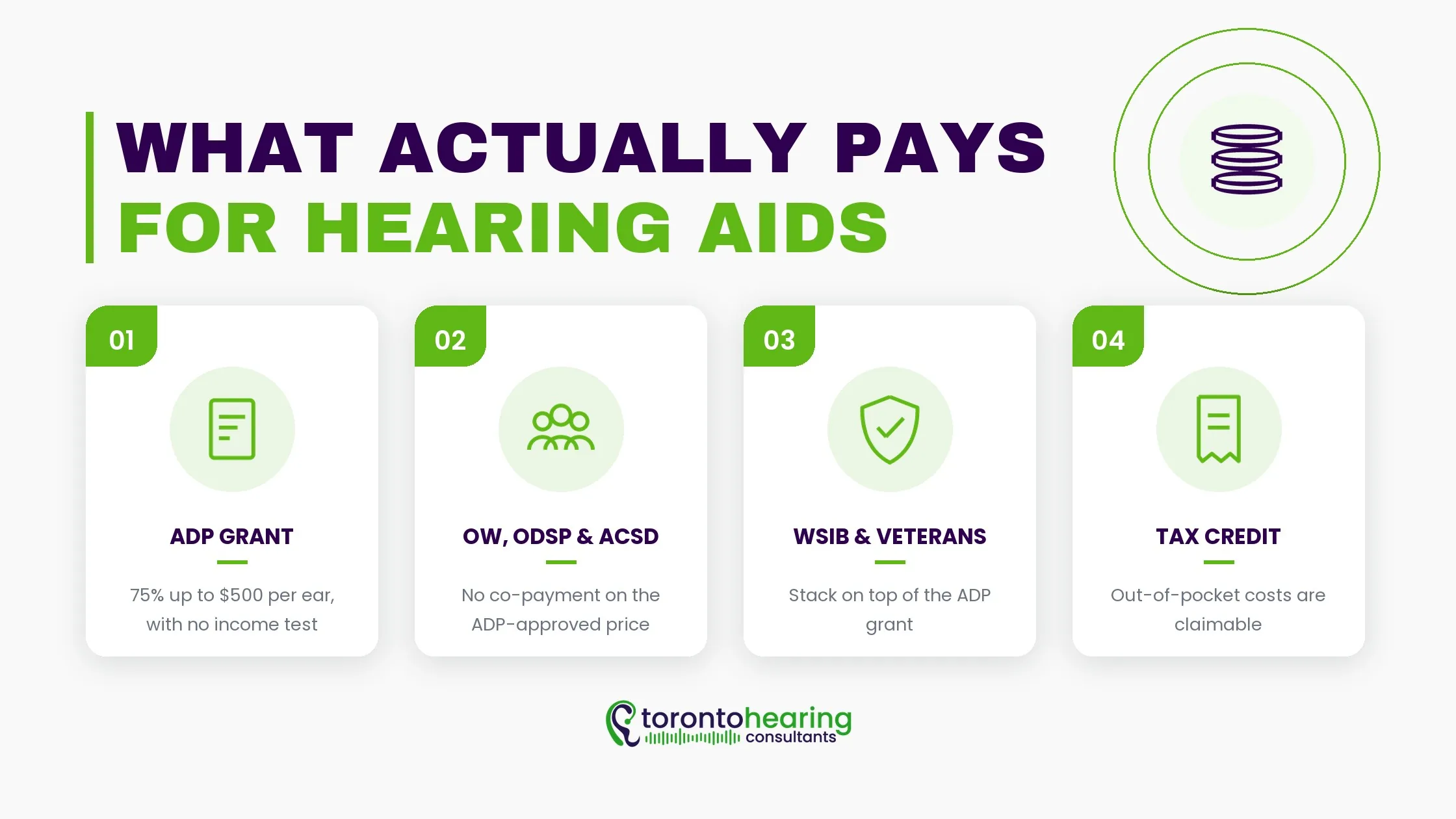
- OHIP itself does not cover hearing aids, and the funding comes instead from Ontario's Assistive Devices Program, which pays three quarters of the cost up to $500 per side.
- The program does not consider your income, so eligibility depends on residency, a valid health card, and hearing loss requiring a device for six months or longer.
- People receiving Ontario Works, the Ontario Disability Support Program, or Assistance for Children with Severe Disabilities can receive full coverage, subject to program maximums.
- Workplace insurance, the Workplace Safety and Insurance Board, Veterans Affairs Canada, and Non-Insured Health Benefits can all stack on top of the provincial grant.
- Hearing aids are an eligible medical expense on your tax return, which recovers a further portion of what you pay out of pocket.
The Assistive Devices Program is the Ontario government program that funds hearing aids, covering 75 percent of the cost up to a maximum of $500 per side, or $1,000 for a pair. OHIP does not pay for hearing aids directly, which is the single most common misunderstanding we hear.
That distinction confuses almost everyone who walks into our Toronto Hearing Consultants clinics. This guide sets out what the province actually pays, who qualifies, and every other program that can shrink your bill.
Does OHIP Cover Hearing Aids in Ontario?
Not directly, and the distinction matters more than it sounds. OHIP covers your physician visits. The hearing test itself is not covered at all, and the hearing aids are funded through a separate provincial program, the Assistive Devices Program, run by the Ontario Ministry of Health.
The practical effect is the same, meaning money from the province toward your hearing aids, but the paperwork, the eligibility rules, and the amounts all belong to that program rather than to OHIP. When people search for whether OHIP covers hearing aids, this is the answer they are actually looking for.
One detail is worth knowing before you start. Hearing aids in Ontario require a prescription, and the province permits only two kinds of professionals to write one: audiologists and physicians.
What the Assistive Devices Program Pays
The program contributes three quarters of the cost of a hearing aid, up to a maximum of $500 per side. If you need two hearing aids, which most people with hearing loss in both ears do, that comes to as much as $1,000 toward the pair.
A few details are worth knowing:
- The grant applies per device, so one hearing aid attracts up to $500 and a pair attracts up to $1,000.
- Frequency modulation systems, which transmit a speaker's voice directly to your hearing aids, have their own category funded at three quarters of the cost up to $1,350.
- You must buy through a registered vendor for the funding to apply, and Toronto Hearing Consultants is a registered clinic that handles the paperwork for you.
- Replacement funding depends on your hearing having changed, or on the devices being worn out, out of warranty, and not repairable at a reasonable cost. The program does not replace lost or misused devices.
At our clinics, the prices we quote already have the grant built in. A pair of entry-level hearing aids runs $2,400 to $2,600 after the $1,000 subsidy, and you can see the full breakdown of hearing aid prices in Toronto before you ever book an appointment.
Who Qualifies for Assistive Devices Program Funding
Eligibility is simpler than most people expect. You qualify if you live in Ontario, hold a valid Ontario health card, and have a disability requiring a hearing device for six months or longer, assessed and prescribed by an authorized professional.
That is the whole list. The program does not consider your income, so your earnings, your age and your assets play no part in it. A retired teacher and a working executive receive exactly the same $500 per side.
Ontario Works, Disability Support and Severe Disability Recipients
People receiving support through Ontario Works, the Ontario Disability Support Program, or Assistance for Children with Severe Disabilities can receive full coverage, subject to the maximums set out in the program's policy manual. If this applies to you, tell your clinic before the paperwork starts so that it is filed correctly the first time.
How to Apply for Hearing Aid Funding in Ontario
You do not apply on your own, since the process runs through your hearing clinic. Here is how it works at Toronto Hearing Consultants.
- Hearing assessment. An audiologist tests your hearing and confirms whether hearing aids are appropriate, and booking a diagnostic hearing test is the starting point for everything that follows.
- Prescription and selection. If hearing aids will help, we prescribe and recommend devices based on your results, your listening needs and your budget.
- Program paperwork. We complete and submit the forms as a registered vendor, so you send nothing to the government yourself.
- Funding applied at purchase. The grant comes off your invoice directly, and you never wait for a reimbursement cheque.
Other Programs That Help Pay for Hearing Aids
The provincial grant is the foundation, and it is rarely the whole picture, because several programs stack on top of it.
| Program | Who it covers | What it provides |
|---|---|---|
| Assistive Devices Program | Ontario residents needing a device for six months or longer | Three quarters of the cost up to $500 per side, or $1,000 per pair |
| Ontario Works, Ontario Disability Support Program, Assistance for Children with Severe Disabilities | Social assistance recipients | Up to full coverage, subject to program maximums |
| Workplace Safety and Insurance Board | Workers with noise-induced or workplace-related hearing loss | Hearing aids, batteries and repairs for approved claims |
| Veterans Affairs Canada | Eligible veterans | Hearing aids and related services |
| Non-Insured Health Benefits | First Nations and Inuit clients | Hearing aids and follow-up care |
| Private insurance | Varies by workplace or individual plan | Commonly $500 to $3,000 per person on a recurring schedule |
If you worked in construction, manufacturing, transportation, or anywhere else loud, a Workplace Safety and Insurance Board claim is worth investigating before you buy anything. In our clinical experience, many retired workers delay filing a claim because they left their loud workplace decades ago. Noise-induced hearing loss can catch up with you later in life, and an audiologist can help trace your work history to unlock full funding coverage for your devices, batteries, and ongoing care.
Does Private Insurance Cover Hearing Aids?
Many workplace benefit plans include a hearing aid allowance, usually somewhere between $500 and $3,000, renewing every three to five years. The details hide in your benefits booklet under hearing aids or medical equipment.
Toronto Hearing Consultants bills many insurers directly, so the allowance comes off your invoice rather than leaving you to wait on a reimbursement.
Are Hearing Aids Tax Deductible in Canada?
Yes, and the claim is straightforward to make. Hearing aids, their batteries and their repairs are eligible medical expenses under the federal Medical Expense Tax Credit.
The portion you pay out of pocket after the provincial grant and your insurance can be claimed on your return, and for retirees with significant medical expenses, the credit is often meaningful. Keep your receipts, because your accountant will thank you.
What You Will Actually Pay After Funding
Here is the honest arithmetic for a typical Toronto purchase. When calculating your total investment for a pair of mid-range hearing aids in Toronto, the baseline cost typically ranges from $3,800 to $4,400 once the provincial grant is applied.
If your workplace plan contributes $1,500, your out-of-pocket cost lands between $2,300 and $2,900, spread across hearing aids that typically last five years or more, with fitting, verification, and follow-up care included. The medical expense credit then takes a further modest bite at tax time.
Funding will not cover hearing aids in full for most people, and anyone who promises otherwise is not being straight with you. What it does is bring properly fitted, professionally supported hearing care within reach of most Ontario households.
What Funded Hearing Care Actually Changes
The math matters, but it is not the reason people walk into our clinics. Accessing these grants makes premium technology attainable, and that shows up in daily life: confidently following fast-moving dinner conversations with family, hearing the television clearly without turning up the volume, and finishing a long workday without the cognitive fatigue that comes from straining to listen.
Funded care also buys the clinical layer around the device. The grant applies at a registered clinic where an audiologist verifies the fitting against your actual eardrum response, adjusts the programming as your hearing changes, and stays accountable for the outcome across the life of the devices. That combination of technology and continuity is what the funding is really unlocking.
Find Out What You Would Actually Pay
Sticker prices and funding rules only take you so far, and most people just want to know what this will actually cost them. If you want a real number rather than a range, the fastest route is an assessment, and if you have questions about your specific insurance policy, you can start with a complimentary 15-minute consultation at either location to clarify your coverage options before you commit to anything.
We are independent, audiologist-led, and fully registered with the Assistive Devices Program at both of our locations, serving patients across Bloor West Village, the Annex, and the broader Greater Toronto Area. We will walk you through every funding source you qualify for before you spend a dollar.
The assessment itself is $50 for patients over 50, $90 for patients under 50, and $110 for children, and private insurance plans commonly reimburse it. The hearing test is not covered by OHIP, which means no referral and no waiting list. Book a hearing assessment whenever you are ready, or read more about hearing aids in Toronto first.
Frequently Asked Questions
Does OHIP Cover Hearing Aids for Seniors?
OHIP does not cover hearing aids for seniors, and there is no separate seniors' hearing aid program in Ontario. Seniors access the same Assistive Devices Program as everyone else, which pays three quarters of the cost up to $500 per side, or $1,000 for a pair. Age does not change the funding amount and neither does income, since the program is not means-tested. What can change the total is workplace or retiree insurance stacked on top, plus the federal medical expense tax credit.
How Often Will the Program Pay for New Hearing Aids?
Replacement funding depends on your hearing having changed enough to need different devices, or on your current aids being worn out, no longer under warranty and not repairable at a reasonable cost. There is no fixed calendar interval, despite the three-to-five-year figure that circulates widely and actually describes typical private insurance renewal cycles. The program does not fund replacements for devices that were lost or misused. Your audiologist documents the clinical justification as part of the application.
Do I Have to Apply for Funding Myself?
No, and this is the part that relieves most people. The application runs through a registered vendor rather than through you, so a registered clinic completes and submits the paperwork and the grant is deducted from your invoice at the point of purchase. You never deal with the ministry directly, and you never wait on a reimbursement cheque. Toronto Hearing Consultants is a registered clinic at both locations, and the paperwork is handled as part of the fitting appointment.
Does the Canadian Government Pay for Hearing Aids for Seniors?
There is no federal hearing aid program for seniors in Canada. Hearing aid funding is provincial, which means the Assistive Devices Program in Ontario and equivalent schemes elsewhere. Federal programs exist only for specific groups: Veterans Affairs Canada for eligible veterans, and Non-Insured Health Benefits for First Nations and Inuit clients. Workers with noise-induced or workplace-related hearing loss may also qualify through the Workplace Safety and Insurance Board, which sometimes covers the entire cost.
Are Hearing Tests Covered by OHIP?
No, and the answer is a flat one. Hearing tests are not covered by OHIP, and neither is ear wax removal, which was delisted in 2020. Our diagnostic assessment is a fee-for-service appointment: $50 for patients over 50, $90 for patients under 50, and $110 for children. Many extended health plans reimburse it, so it is worth checking your benefits booklet before your appointment. The practical upside is that no physician referral is required and there is no waiting list to join.