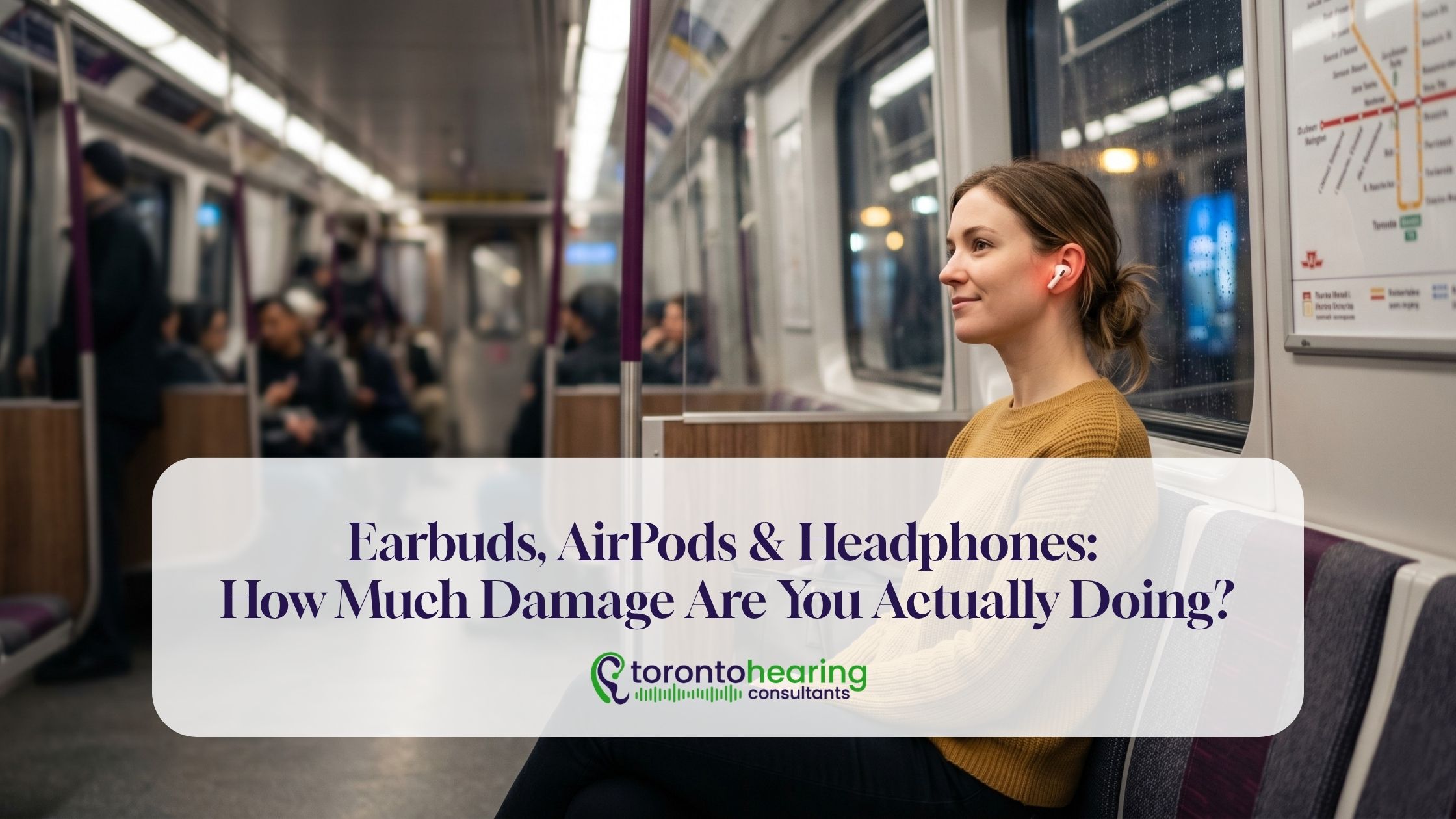
Most people never think twice about putting their earbuds in. Music during a workout. Podcasts on the subway. Calls between meetings. Videos before bed. Headphones have become part of daily life for almost everyone, and because the habit feels so normal, it is easy to assume it is harmless too.
But hearing damage rarely happens all at once. It develops gradually, quietly, and often without obvious warning signs until the effects become difficult to ignore. At Toronto Hearing Consultants, we regularly speak with patients who are surprised to learn that symptoms like ringing ears, listening fatigue, or struggling to hear clearly in noisy places may be connected to everyday headphone use.
The good news is that most headphone-related hearing damage is preventable. Small adjustments to how, when, and how loudly you listen can make a meaningful difference over time. This blog will walk you through what research says about earbuds, AirPods, and headphones, the warning signs to watch for, and the listening habits that can help protect your hearing for the long term.
At a Glance
- How headphone related hearing loss develops over time
- Safe listening levels and why volume matters
- Early warning signs such as tinnitus and listening fatigue
- How daily earbud use can increase hearing risks
- Practical strategies to protect your hearing
- When to consider a professional hearing assessment
- How Toronto Hearing Consultants can help support long term hearing health
The Real Risk: Understanding How Everyday Listening Damages Your Hearing
Headphone-related hearing loss does not happen all at once. It accumulates. Every time sound enters your ear canal at a high volume, the tiny hair cells inside your cochlea absorb that energy. These hair cells do not regenerate. Once they are damaged, they are gone, and the hearing they supported goes with them.
The World Health Organization estimates that more than one billion young people globally are at risk of hearing loss due to unsafe listening practices. According to the WHO, unsafe listening through personal audio devices is now considered one of the leading preventable risks for hearing loss among young adults worldwide.
In Canada, noise-induced hearing loss is among the most common forms of hearing impairment in adults under 50. And the primary culprit is not concerts or construction sites. It is the device in your pocket and the earbuds you put in during your morning commute.
The hearing risks of earbuds are often underestimated because the damage is painless. There is no alarm, no sharp sensation, no obvious moment where things go wrong. That is precisely what makes it so important to understand and take seriously. At Toronto Hearing Consultants, our approach is built around audiologist-led hearing care, which means we help patients understand their hearing at every stage, not just after something has gone wrong.
What Are Safe Listening Levels, and Are You Exceeding Them?
Sound is measured in decibels (dB). A normal conversation sits around 60 dB. A lawnmower runs at about 90 dB. Hearing experts widely agree that consistent exposure above 85 dB begins to cause cumulative damage over time.
Here is the part that surprises most people: popular earbuds and AirPods can produce output levels between 100 and 110 dB at maximum volume. Many people listen at 70 to 80 percent of that maximum, which still puts them solidly in the damage zone during a long commute, workout, or workday.
The relationship between volume and exposure time matters enormously:
- At 85 dB, the safe daily exposure limit is approximately 8 hours.
- At 91 dB, that limit drops to 2 hours.
- At 100 dB, permanent damage can begin in as little as 15 minutes.
The simple benchmark audiologists recommend is the 60/60 rule: listen at no more than 60 percent of maximum volume, and take a break after 60 minutes. It is an easy starting point that makes a genuine difference over the long term. The WHO’s Make Listening Safe initiative also encourages practical listening habits like volume moderation and exposure limits to help reduce long-term hearing damage from personal audio devices.
To get a clearer picture of where your hearing stands today, consider booking a professional hearing test in Toronto. Even if you have no obvious symptoms, a baseline assessment is one of the most useful things you can do for your long-term hearing health.
Tinnitus, Fatigue, and the Warning Signs You Should Not Ignore
Most people associate hearing loss with difficulty understanding speech or needing to turn the TV up. But the early signs of headphone-related hearing damage are often subtler, and they show up long before significant loss is detectable on a standard test.
Types of Hearing Problems Linked to Earbud Use
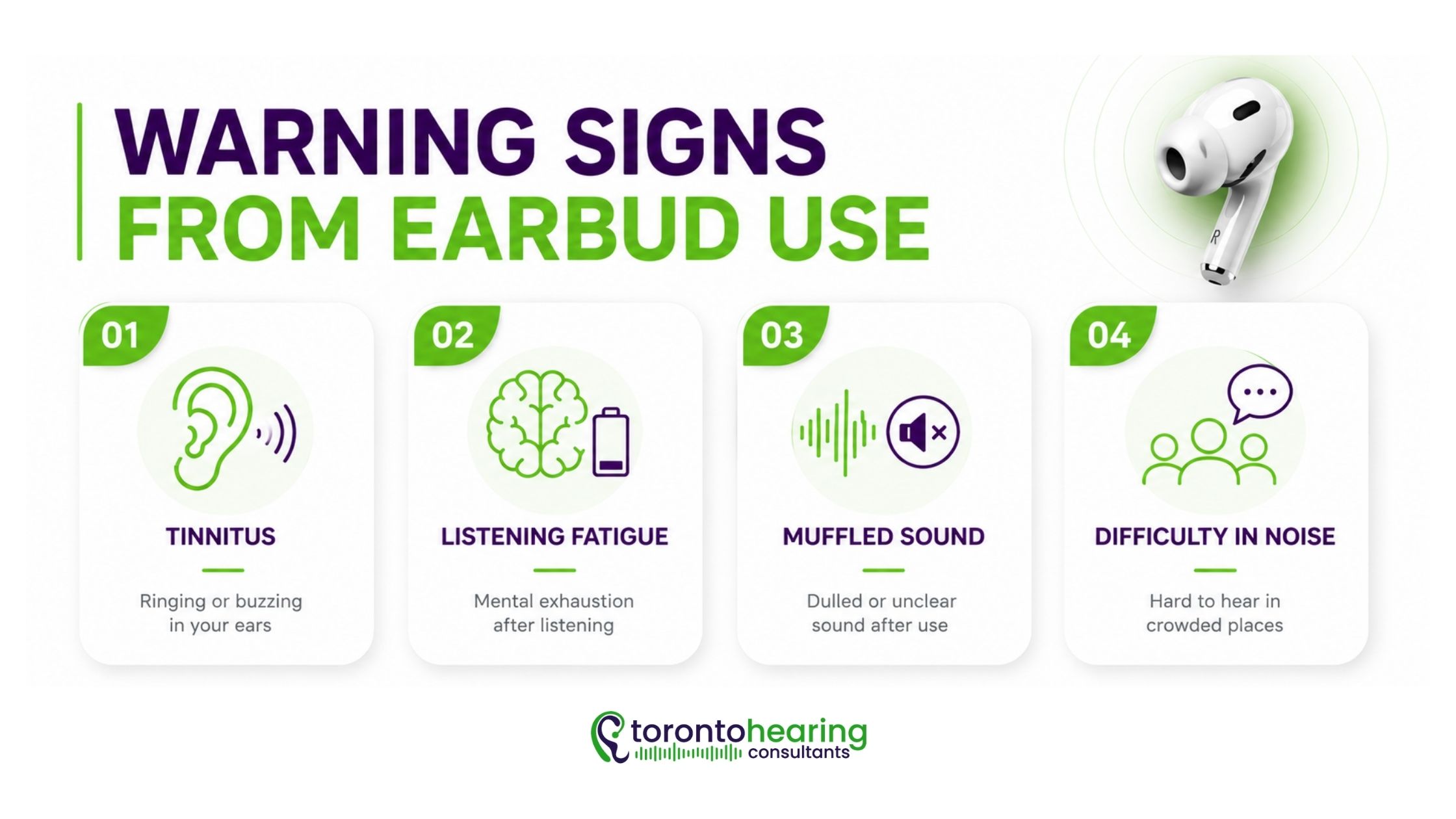
Watch for any of the following:
Tinnitus from headphones
A ringing, buzzing, or whooshing sound in one or both ears, especially after a long listening session. Even temporary tinnitus is a signal that your auditory system is under stress. The Canadian Academy of Audiology explains that tinnitus can be linked to noise exposure, hearing loss, stress on the auditory system, and other underlying hearing health concerns that should be professionally evaluated.
Listening fatigue
Feeling mentally drained after calls, meetings, or audio content, even when the volume seems reasonable. This is your brain working harder to process sound that is arriving with less clarity.
Muffled sound
A temporary dulling of sound quality after exposure. This is called a temporary threshold shift and is an early indicator of noise-induced damage. Health Canada notes that repeated exposure to loud sound can damage the inner ear over time, contributing not only to hearing loss but also to persistent tinnitus symptoms.
Difficulty hearing in noise: Struggling in restaurants or group settings, even though one-on-one conversations seem fine. This is a classic early pattern of cochlear damage.
If any of these sound familiar, we encourage you to explore our complete hearing care services. Our audiologists take the time to understand your listening history, lifestyle, and concerns before recommending any next steps.
Occupational and Daily Use: When Exposure Adds Up Faster Than You Think
It is not just recreational listening that puts hearing at risk. For many Torontonians, earbud use has become embedded in their workday. Remote workers spend hours on video calls. Commuters listen through a full subway ride. Gym-goers power through a 90-minute workout. Students study with music on, then take calls, then watch videos in the evening.
When you add these sessions together, it is easy to see how a person might accumulate five or six hours of daily earbud use without realizing it. And that daily total is what matters most. The auditory system needs recovery time, just like any other system in your body. When it does not get it, the cumulative load builds.
Occupational risks are also worth mentioning. If your work environment involves machinery, music, or ambient noise, and you use earbuds on top of that, your total noise exposure may be significantly higher than you assume. Canada’s occupational health guidelines set 85 dB as the exposure limit for an 8-hour workday, but that threshold applies to all combined sources, not just your headphones.
Canadian research published by Statistics Canada has also shown that ongoing workplace and environmental noise exposure continues to play a significant role in hearing-related health risks for adults across the country.
If you are experiencing ear discomfort, fullness, or wax buildup after regular earbud use, you may also benefit from safe ear wax removal services. Earbuds worn frequently in the ear canal can push wax deeper and create blockages that affect both comfort and hearing clarity.
Healthy Listening Habits: Prevention Strategies That Can Work
Protecting your hearing does not mean giving up music, podcasts, or calls. It means building a few smart habits that let you enjoy all of it, for decades to come. Here is what our audiologists recommend:
- Use the 60/60 rule. Sixty percent volume, sixty minutes at a time. Set volume limits on your device if the option is available.
- Choose over-ear headphones when possible. They sit further from the eardrum and generally require lower volume to achieve the same perceived loudness as in-ear designs.
- Opt for noise-cancelling models. Active noise cancellation reduces ambient sound, which means you do not need to turn the volume up to hear over your environment.
- Give your ears recovery time. After long listening sessions, allow at least 30 to 60 minutes of quiet before your next session.
- Monitor your exposure. Both iOS and Android platforms now offer hearing health features that track your weekly audio exposure and alert you when levels are consistently high. Use them.
- Get your hearing checked regularly. A hearing assessment every one to two years is a reasonable baseline for adults who use headphones frequently.
If you are already using hearing technology and want to make sure your setup is supporting rather than stressing your hearing, our team can help with personalized hearing aid solutions that are chosen based on your specific hearing profile and daily listening needs.
How Toronto Hearing Consultants Can Help You Stay Ahead of Hearing Loss
Toronto Hearing Consultants is an independent, audiologist-led hearing clinic with two convenient locations across the city. We are not a retail chain. We are not driven by product quotas. Our focus is on providing personalized, education-first care that helps patients understand their hearing and make informed decisions, at every stage of life.
Whether you are starting to notice the early signs of listening fatigue, dealing with ringing in your ears after long listening sessions, or simply want to establish a hearing baseline before any issues develop, we are here to help. Our audiologists take the time to understand your lifestyle, your work environment, and your listening habits before making any recommendations.
For those already using hearing devices, we also provide hearing aid accessories and support to make sure your technology continues to work as well as it should.
Hearing loss is rarely dramatic. It creeps in slowly, and by the time most people notice it, some of it is already permanent. Early detection changes that story entirely. A simple, comfortable hearing test gives you real information about where your hearing stands today, and what you can do to protect it going forward.
Discover how better hearing can improve daily life and what proactive hearing care actually looks like in practice.
Key Takeaways
- Headphone hearing damage is gradual, cumulative, and largely preventable with the right habits.
- Safe listening levels are 85 dB or below; many earbuds at mid-to-high volume exceed this significantly.
- Tinnitus, listening fatigue, and muffled sound are early warning signs worth taking seriously.
- Noise-cancelling headphones, volume limits, and regular listening breaks make a meaningful difference.
- Regular hearing assessments are the most reliable way to catch changes before they become permanent.
Frequently Asked Questions
Can earbuds really cause permanent hearing loss?
Yes. Prolonged exposure to sound above 85 decibels through earbuds can permanently damage the hair cells in your cochlea. These cells do not regenerate, which is why noise-induced hearing loss is irreversible once it develops.
How loud is too loud when using headphones?
Most audiologists recommend keeping volume at or below 60 percent of your device’s maximum output and taking breaks of at least 30 minutes after every hour of listening. If someone nearby can hear audio leaking from your earbuds, the volume is too high.
What does listening fatigue feel like?
Listening fatigue typically presents as a sense of mental tiredness or difficulty concentrating after extended audio exposure. Some people describe it as needing to work harder to follow conversations, even when volume is not a problem. It is a sign the auditory system is being overtaxed.
How do I know if my hearing has been affected?
A professional hearing test is the most reliable way to identify changes in your hearing. Ringing in the ears, temporary muffling after listening sessions, or difficulty hearing in noisy environments are common early indicators worth discussing with an audiologist.
How often should I get my hearing tested if I use headphones regularly?
For adults who use earbuds or headphones daily, a hearing assessment every one to two years is a reasonable approach. This allows your audiologist to track any changes over time and address them before they progress.
Ready to Take the First Step Toward Better Hearing?
Understanding how your daily listening habits affect your hearing is the first step. The next one is just as simple. We invite you to speak with a Toronto audiologist at Toronto Hearing Consultants and get a clear picture of where your hearing stands today.
You do not have to wait for a problem to develop before you take action. You can book a free 15 minute consultation to get started and explore your options.
If you decide to book an assessment, please note that a hearing assessment is a comfortable, straightforward process, and the information it provides can genuinely shape the choices you make about how you listen every day.